


Gantry robots do not require complex movements, as their work objects are single and their structures are relatively simple. They are commonly used in automated processing scenarioses and are currently specialized robots used for auxiliary material handling operations in industries such as machine tool manufacturing and injection molding. However, achieving their movements is not as simple as dragging them; tasks must be processed and completed through programmable software, which relies on the robot's control system to execute.
Generally, a complete and functional robotic arm system consists of the following components: the arm body, servo motors, hardware for each axis, and the crucial “control system” that serves as the brain of the system.
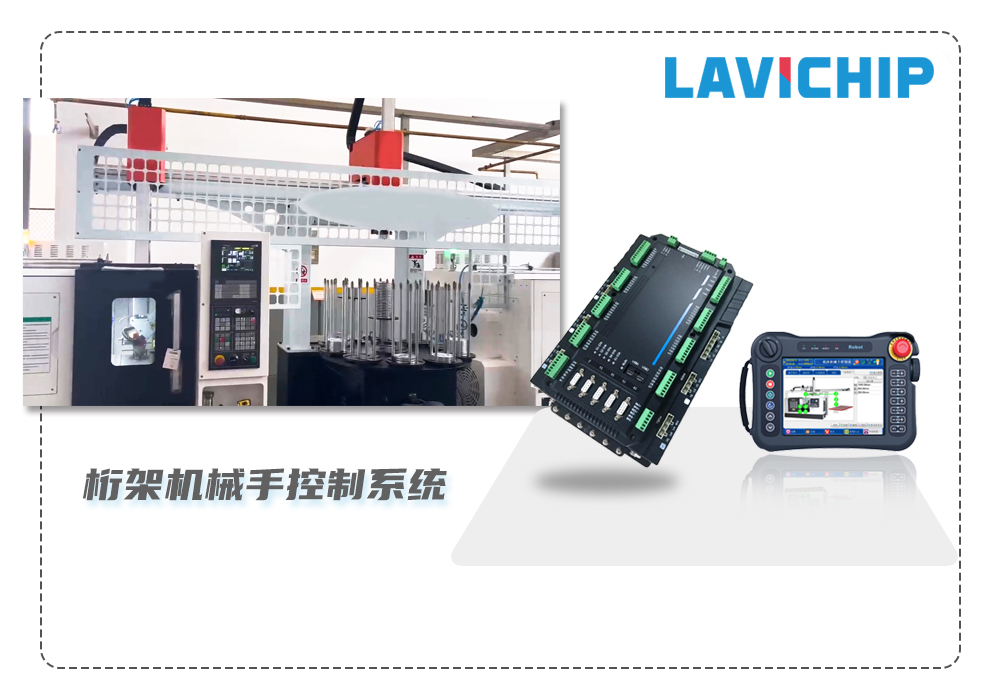
The up, down, left, and right movements of the gantry manipulator are driven by a hydraulic system controlled by a double-coil two-position solenoid valve. The gantry manipulator moves the workpiece and performs task operations, all of which are controlled by a dedicated manipulator control system. For example, in a simplified workflow: the manipulator moves to the workpiece position, clamps the workpiece to pick it up, then moves to the next processing position for placement, and returns to the original workpiece position to form a cycle.
The gantry manipulator must perform a series of actions, including gripping the workpiece, raising the arm, stretching, rotating, and moving. These actions must be completed to finish a feeding process, which has a time-based cycle. Due to the different directions and positions of these movements, a high-precision motion controller is required to drive the actuators, ensuring high precision and rapid response for gripping and handling operations.
Gantry Manipulator Control Process:
The gantry manipulator is at the origin pickup position, and the CNC machine tool sends it a loading signal. The gantry manipulator's lifting cylinder receives the command to start operating, causing it to descend along the Z-axis to the pickup locations to grasp the workpiece. The ascending solenoid valve energizes the motor, causing the manipulator to ascend along the Z-axis to the gantry (after the manipulator ascends to the gantry, it contacts the upper limit switch, causing the ascending solenoid valve to de-energize, stopping the ascent), then moves along the X-axis to the position above the machine tool. It begins descending while sending the robot's operational area model to the machine tool, descends to the machine tool chuck, opens the clamping device to place the workpiece into the chuck, and the machine tool chuck tightens. The robot then ascends along the Z-axis back to the gantry position while sending a signal to the machine tool indicating it is ready for unloading. At this point, the robot's ready light illuminates, and it waits for the CNC machine tool to send the unloading command.
This article discusses the working and control processes of gantry robots. To operate them effectively, a professional robot control system is essential to enable the robot to perform material handling tasks. Programs are written through a human-machine interface (teaching pendant), and the controller's advanced motion control algorithms ensure precision in operations. Even novice operators can use the Lavichip control system to operate gantry robots for manufacturing tasks.